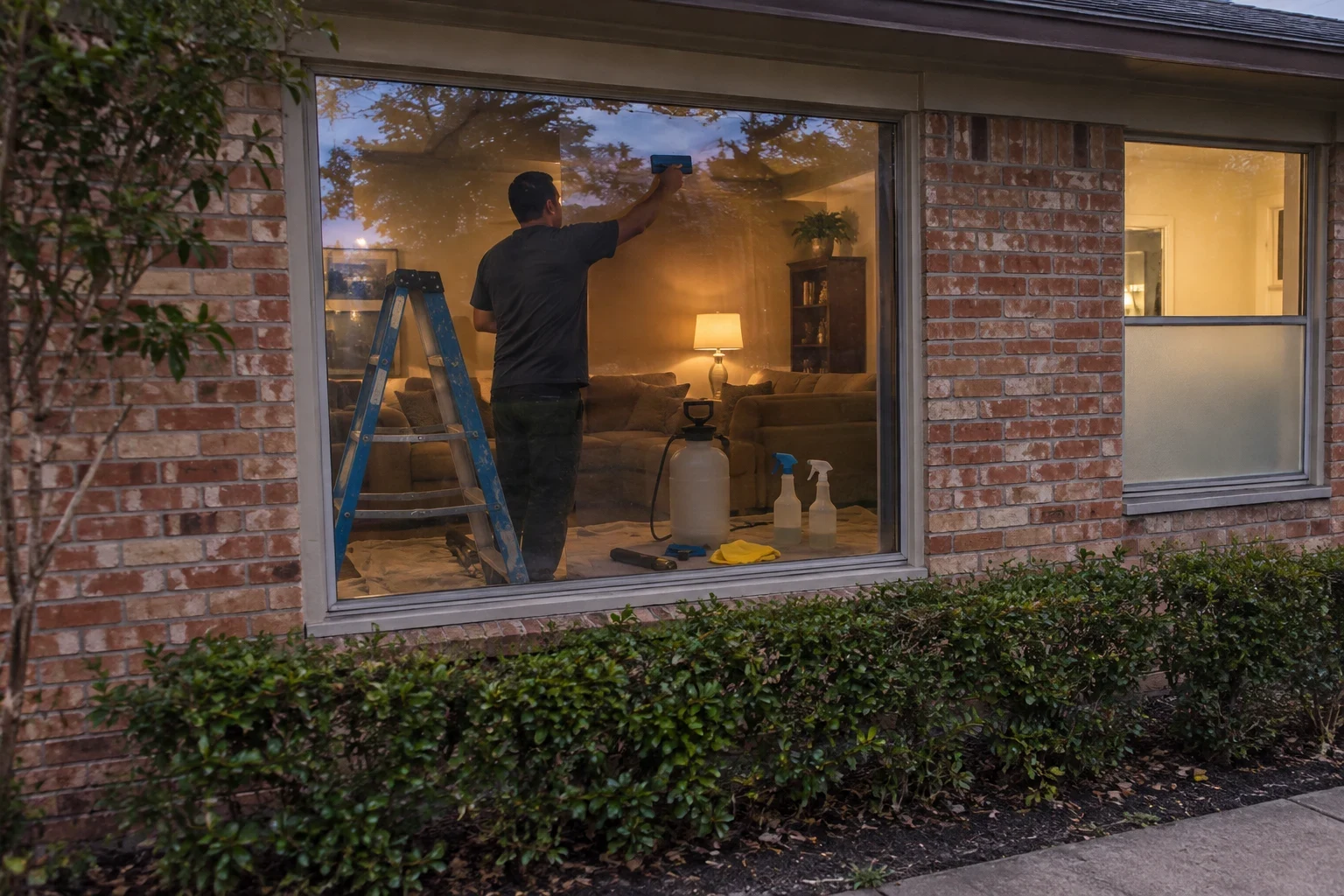
Is there a one-way privacy window film that works at night in West University Place?
Mirror film does a good job in daylight, but it follows the light, not your schedule, and that changes which film belongs on which window.
Is there a one-way privacy window film that works at night?
No. One-way mirror film only works when the side you want hidden is darker than the side looking in, so at night, with lamps on inside, it flips and neighbors can see in. For real nighttime privacy you need film that blocks the view in both directions, such as frosted or patterned film, or pair mirror film with shades.
Why does one-way film stop working after dark?
So-called one-way film is a reflective film. A thin metallized layer bounces back part of the light that hits it and lets the rest through. Whoever stands on the brighter side mostly sees their own reflection. Whoever stands on the darker side sees straight through, the same way a lit storefront at dusk shows its display to the street while the shoppers inside mostly see their own reflection.
On a sunny afternoon the outdoors is far brighter than your living room, so people outside see a mirror and you see the yard. After sunset the ratio reverses. Your lamps make the inside the bright side, the street goes dark, and the film now shows the room to anyone outside while you see your own reflection in the glass.
This is not a defect, a cheap film or a bad install. Every reflective film behaves this way because it is a property of reflection itself. A darker or more mirrored film shifts the balance a little, but it cannot beat a lit room on a dark night.
Which window films keep a room private at night?
Night privacy comes from film that scatters or blocks light instead of reflecting it. These films work the same in both directions, so it does not matter which side is brighter. The tradeoff is that you also lose a clear view out.
- Frosted or matte film: diffuses light so shapes blur into soft glow. Rooms stay bright in the day and private after dark.
- Decorative patterned film: etched-glass looks, lines or textures that break up the view while letting light pass between the pattern.
- Gradient film: solid at the bottom, fading to clear at the top, so seated or standing height is screened and the sky still shows.
- Opaque white or blackout film: blocks the view and most light completely, useful for media rooms or glass that faces a close neighbor.
- Dual-reflective film: less mirror effect on the interior side so the view out at night is clearer, but it still does not hide a lit room from outside.
How do you get daytime views and nighttime privacy on the same window?
Most homeowners do not need the same answer on every pane. A common setup is reflective or ceramic film on the big view windows for heat rejection and daytime privacy, with shades or curtains closed in the evening. The film handles the hot hours, and the window covering handles the dark hours.
Where shades are not practical, splitting the glass works well. Frosted film on the lower sash of a bathroom or bedroom window, clear or tinted glass above, keeps the sightline from the sidewalk blocked while you still get daylight and a slice of sky. Gradient film does the same thing on a single large pane without a hard line.
For sidelights next to the front door, transoms and glass shower walls, decorative film is usually the cleanest fix. Those are the panes people tend to forget until they notice someone can see down the hallway at night.
What we check before recommending a privacy film
The right film depends on why a window feels exposed, so we start there instead of with a sample book. We ask which rooms you use after dark, then stand where a neighbor or passerby would stand and look back at the glass. A second-story window that only faces trees may need nothing for nighttime, while a ground-floor bedroom near the street might need frosted film on the lower half.
We also look at the glass itself. Many homes around Houston have dual-pane or low-E windows, and dark or highly reflective films raise the temperature of the inner pane. On large panes in direct afternoon sun that added heat can stress the glass or the seal, so we match the film's absorption to the window rather than guess.
Finally, check whether your deed restrictions or HOA limit mirrored exteriors. Some do, and a non-reflective or frosted film can solve the privacy problem without changing how the house looks from the street.
- Rooms used at night and what can be seen from outside
- Single-pane, dual-pane, low-E, tempered or laminated glass
- Sun exposure and heat load on each elevation
- Whether you want to keep a view, or just keep light
Does security window film add privacy?
Standard security film is a thick, clear polyester laminate. Its job is to hold broken glass together after an impact so the pane stays in the frame longer, which slows a break-in and reduces flying shards in a storm. On its own, clear security film adds no privacy day or night.
If you want both, there are tinted and reflective security films, and security film can be installed with a frosted or decorative layer on panes that need screening. The same physics applies: a reflective security film is private in daylight only, while a frosted layer stays private after dark.
More questions about nighttime privacy film
Can I still see out through frosted film?
You will see light, color and movement, but not clear detail. If you need to see the yard, use frosted film only on the lower portion of the glass or choose a gradient pattern.
Is reflective film still worth it if I close the shades at night?
Often yes. It cuts heat, glare and UV during the hours the sun is actually on the glass, which is when it matters most for comfort and fading.
Can privacy film be removed later?
Yes. Residential window films are applied with an adhesive that can be stripped by an installer, so you can change the look if your needs change.
Does a lighter interior lamp setup help mirror film at night?
Only slightly. Dimming lights narrows the gap between inside and outside, but any lit room will still show through reflective film after dark.
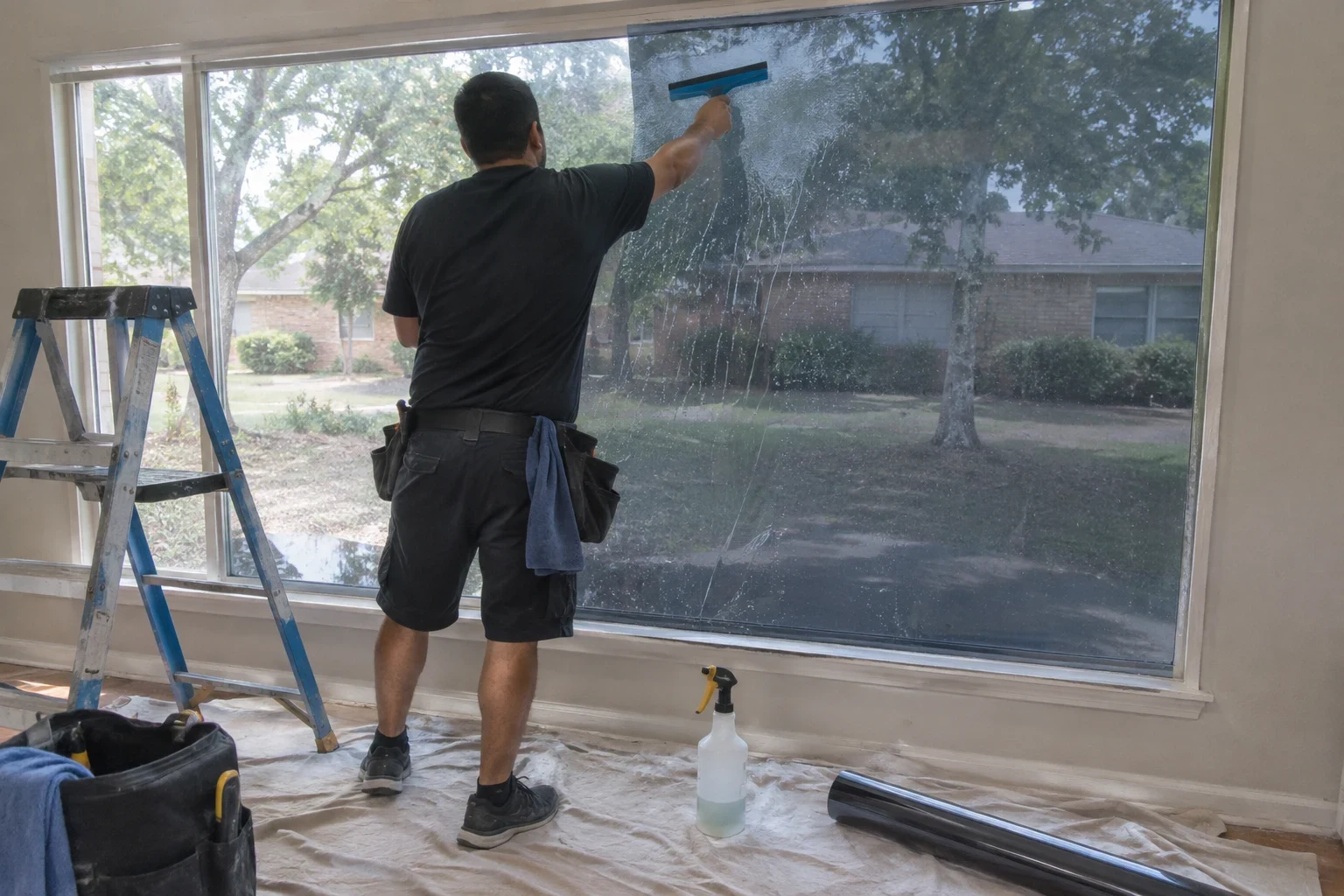
Find out which windows actually need night privacy
We will look at each window, where it can be seen from and what glass it is, then tell you which film works day and night and which panes only need shades. You get a clear recommendation and a free quote over the phone.